
From Burnout to Buy-In: What Outdoor Team Experiences Offer That Holiday Parties Don’t
- marketing01884
- Dec 16, 2025
- 2 min read
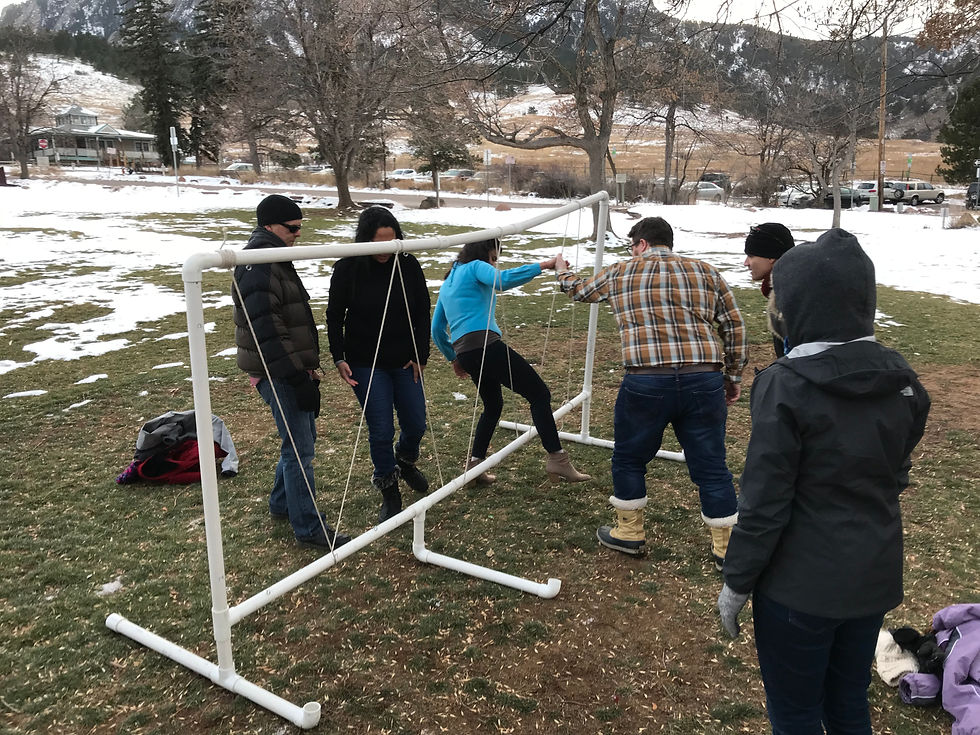
End-of-year celebrations are a familiar feature of workplace culture. Holiday parties provide a pause, a moment of recognition, and a chance to gather outside the day-to-day rhythm of work. But as teams return from the holidays, many organizations find that connection, alignment, and energy remain uneven.
This gap highlights a broader distinction between social events and experiential team development. While holiday parties can mark an ending, they rarely support the deeper outcomes teams need moving into a new year.
The Limits of Passive Social Events
Holiday parties are designed to be inclusive and low-effort. Attendance is optional, participation is informal, and outcomes are largely social. While these events can boost short-term morale, they tend to fall short in areas that matter most to long-term team performance.
Common limitations include:
Minimal interaction across roles or departments
Existing hierarchies remaining intact
Little opportunity for collaboration or shared problem-solving
No structured reflection or skill development
As a result, teams often leave these events entertained but unchanged.
Why Shared Challenge Creates Stronger Buy-In
Research in organizational psychology and experiential learning consistently shows that shared challenge builds trust more effectively than passive interaction (Kolb,1984). When individuals work together toward a common goal—especially in unfamiliar environments—patterns of communication, leadership, and decision-making become visible.
Outdoor team experiences leverage this dynamic by:
Placing participants on equal footing outside traditional office roles
Encouraging collaboration under manageable stress
Requiring adaptability, communication, and mutual support
These conditions create space for authentic connection and collective problem-solving.
Movement, Environment, and Cognitive Reset
Physical movement plays a critical role in how people engage with one another. Studies link movement to improved cognition, emotional regulation, and creativity—factors that directly impact team dynamics (Ratey, 2008).
Outdoor environments further support this reset by:
Reducing digital distractions
Encouraging presence and focus
Creating natural opportunities for informal conversation
For teams experiencing burnout or disengagement, stepping outside the workplace context can significantly shift group energy and perspective.
From Experience to Insight: The Role of Facilitation
The most effective outdoor team experiences are not simply activities; they are facilitated learning environments. Structured reflection transforms shared experiences into insights that translate back to the workplace.
Facilitated debriefs often explore:
Communication styles under pressure
Decision-making processes
Leadership emergence and followership
Trust, risk tolerance, and accountability
This reflective layer is what distinguishes experiential team development from recreational outings.
Why Timing Matters After the Holidays
The period immediately following the holidays is a critical transition point. Teams are re-establishing routines, setting priorities, and navigating shifting workloads. Rather than adding another celebratory event, many organizations benefit from experiences that support re-alignment and forward momentum.
Outdoor team experiences during this period can help teams:
Reconnect after time apart
Reset expectations and communication norms
Build shared language around collaboration and leadership
Moving Beyond Celebration Toward Capability
Holiday parties mark a moment in time. Experiential team development builds capability that lasts beyond a single event. For organizations seeking stronger buy-in, improved collaboration, and sustainable performance, the distinction matters.
Outdoor experiences offer teams more than a break from work—they provide a framework for learning how to work better together.
Kolb, D. A. (1984). Experiential Learning: Experience as the Source of Learning and Development.
Ratey, J. J. (2008). Spark: The Revolutionary New Science of Exercise and the Brain.


Comments